

Excerpts from a Travelogue - Part IV
Part IV - Italy, Vatican City
Florence, the capital of Tuscany was the next port of call for which we budgeted the extended time of about one hour. We parked, walked fast to center, and then walked back. We came, we saw, we said, ok, great, lovely, let’s move on. To those not yet jaded by cathedrals of great fame—think the Duomo Cathedral Santa Maria del Fiore—this would be a shame. But it was wettish, of course, and Florence was not really on the itinerary - but the countryside of Tuscany was most certainly on the itinerary, as were the hill towns, and of course, the Leaning Tower of Pisa.
Pisa was another serendipitist moment: I had not thought we'd see the Tower, but Mike said, Hey, let’s do it and so we did, it being only an hour or two out of the way. It ended up being another highlight; we were all glad we’d taken the detour. Thanks, Mike.
Pisa was busy, tourists galore. But guess what? The sun came out and blessed our stay; we exchanged rain moisture for sweat moisture.
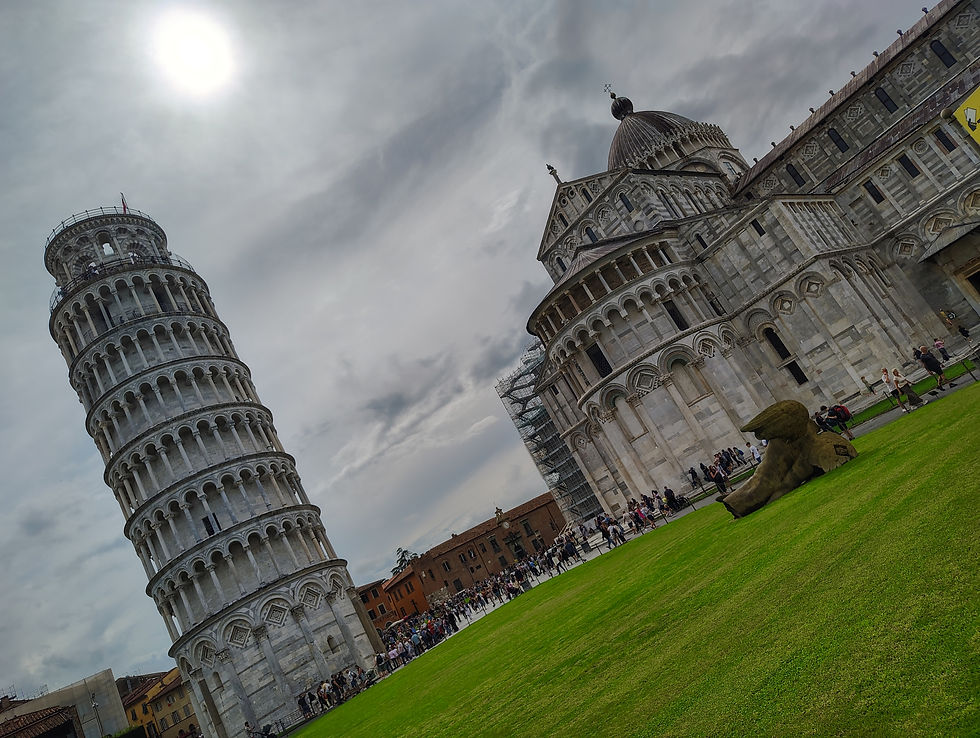
The Leaning Tower, built in the 12th century, was quite an experience: nausea inducing initially, the 4-degree lean causing disequilibrium and weird sensations. We climbed to the top and were able to view the grounds below that included a large baptistry (Battistero de San Giovanni) and the Pisa Cathedral.
Besides climbing the tower, we toured the Pisa Baptistry. The Baptistry is a massive dome-roofed edifice, akin to a cathedral, where every 15 to 20 minutes a young lady would hush the crowd, all the doors would be closed, and she would sing operatic notes, hold them, then wait as the sound gathered far up in the overarching rotunda, echoing, and creating lovely harmonies. Well, lovely is perhaps an overstatement, but it was quite nice.


On to the hill towns of Tuscany. The sun played hide and seek all day, clouds lingered which is becoming a broken record by now. But wait, things do improve.
By darkness we had arrived at the famous hill town of Montepulciano with gastronomical hopes and dreams of eating supper within the old stone walls of this ancient town. But no, turns out you need reservations weeks in advance for most of the places. This town is famous for its wine and thus we would have not been so welcome with our teetotalling “I’ll have water with lemon, please.”

These hill towns at night are probably as much or more spectacular than in day, all lit up, veritable fortresses with high stone walls, turrets, and windows looking over breathtaking drops to valleys far below.

We ended up in the neighboring village of Chianciano Terme, a 15-minute drive down the valley, at an art deco style inn where the two proprietors had us park right next to the door, took our passports, registered us with the police, and wished us a good night. They then shut off the lights, locked the doors, and left. We walked to their recommendation for supper, just down the street where we enjoyed a truly nice, slow, and tasty meal.
And this is where it gets better. The next morning, we awoke to a dazzling sun coming up in a deep blue sky, the kind of blue that only comes after a thorough sky-wash. The patio looked out over the town, the streets, the hills beyond, all bathed in a sparkling morning brilliance. Our hearts lifted and we made plans for a spectacular day with a final day's end destination of the Amalfi Coast.
But first a detour. Mike and Sharla had a first cousin who just happened to be here in Tuscany on vacation and was staying at an “Agrotourismo,” a guest farm in the hill country. We received the warm invite to visit with great interest and navigated the winding narrow road to find a truly picturesque tableau of steeply rolling hills, recently plowed, small dairy farms, and driveways all lined with the iconic Tuscan cypress. We sat outside, toured the farm, made connections, and left with smiles, saying to ourselves, “What a lovely way to spend an Italian fall morning.”

We drove south then, following the call of the Amalfi Coast. A few hours past the outskirts of Rome found us south of Naples, up the incredibly steep and winding roads above the city of Sorrento, where we had booked an Airbnb for two nights.
We explored the seacoast, first in Sorrento, and then down the dangerous, cliff hanging, winding two lane that serpentines its way down the coast. Positano and Amalfi were on the list today, and we enjoyed sunshine, clear blue skies, deep blue and turquoise waters, breathtaking views. The steep hillside hugging towns were busy, slow traffic, difficult to find parking, but well worth the visit.

We hiked down through the town of Positano, hundreds of steps, through narrow whitewashed back alleys, following signs to the water, the beach, and the promenade. I find it difficult to describe the villages—but let me try: they are basically vertical towns; houses and shops built into a cliff, starting at the base of pebbly-edged small beaches that circle in and out of horseshoe-shaped, turquoise-tinged coves, and then clinging to the steep rocky slopes that soar upward. People actually live here and, I assume, catering to tourists their main occupation.

Of note here was the parking. We found a small cave-like parking garage run and coordinated by 3 or 4 attendants. I say coordinated, because that's exactly what it was. You relinquish your precious keys, and they jockey your car into an impossible position somewhere in the garage depending on your estimated return time. When you get back there is much yelling, motioning, inching forward and backward until your car is finally somewhere where you can exit and breathe a large sigh of relief. Space is at a premium here. We had this similar experience in larger garages in Florence and Rome. Leave your keys, trust the garage attendant to not sell your car, and they find this tiny space for it to sit in until you return. Somehow it all works.
What more can we say about the Amalfi, Sorrento, and the Naples region? It was an adventure, if nothing else, the driving was insane, as we say nowadays. Narrow roads, fearless drivers, scooters and taxies passing with apparently no thought that there could possibly be a vehicle coming around that next blind corner. And the drop offs! One wrong move and your kite surfing your car over the Tyrrhenian Sea. Eyes on the road. Navigation performed by the first officer. Gasps and deep inhales performed in synchrony by the occupants of the back seat.

From the porch of our Airbnb, we had the somber view of Mount Vesuvius in the distance, an imposing dark crater, quietly but sternly overlooking the Bay of Naples, and the surrounding hills. I gazed at this many times during our stay, wondering about the fateful day back in AD 79 when the mountain blew, covering the town of Pompeii with lava and ash. Simply stopped the city in time. What would that look like? Well, we were about to find out.

After some indecision, and after circling the ruins of Pompeii twice by reason of navigational error, we decided we had come this far and we better take at least a little time to visit the ruins. There is too much to see, even for a full day. An entire city, buried all those years ago, now revealed for all to look upon. The Encyclopedia Britannica does the short overview best:
"Pompeii - a preserved ancient Roman city in Campania, Italy, 14 miles southeast of Naples, at the southeastern base of Mount Vesuvius. Around noon on August 24, 79 AD, a huge eruption from Mount Vesuvius showered volcanic debris over the city of Pompeii, followed the next day by clouds of blisteringly hot gases. Buildings were destroyed, the population was crushed or asphyxiated, and the city was buried beneath a blanket of ash and pumice. For many centuries Pompeii slept beneath its pall of ash, which perfectly preserved the remains. When these were finally unearthed, in the 1700s, the world was astonished at the discovery of a sophisticated Greco-Roman city frozen in time. Grand public buildings included an impressive forum and an amphitheater; lavish villas and all kinds of houses, dating back to the 4th century BC, were also uncovered. Inside were some preserved remains of people sheltering from the eruption; others lay buried as they fled; bakeries were found with loaves still in the ovens. The buildings and their contents revealed day-to-day life in the ancient world..."
Hot, sticky, tired, overwhelmed by the fate and tragedy of it all we retired to the car, turned north, destination the Eternal City, Rome.
Part V coming soon.
In her armchair sat a Christian
Traveling far flung places,
Names I cannot even pronounce
Climbing well worn steps
Walking at an angle,
Gasping with the back seat occupants
Sighing over a city preserved in ash
Thank you for the gift of stationary tourism.